rammstein-auslander – play.muzfan.net
Chapter 13:
Childfree
“Free from Children”
“The category of people who do not have children as a matter of principle has long become familiar and accepted. They are free from children and responsibility, living for themselves and their own pleasure. Society does not condemn such people, and this is considered normal. However, every year the number of convinced opponents of motherhood and fatherhood increases (as a rule, in economically developed countries). German women are no exception: many cannot give up their accustomed lifestyle—work, sports, travel, entertainment. They do not want to abandon all of this for the sake of children.”
And in conclusion, an excerpt from the information portal germania-online:
“The birth rate in Germany has become the lowest in the world. Over the past five years, an average of 8.2 children were born per 1,000 inhabitants. This is lower than in Japan, which traditionally used to close this sad ranking.”

These are the results of a study conducted by researchers from the Hamburg Institute of International Economics (HWWI) together with the auditing company BDO. The scientists analyzed indicators that are not standard for such statistics. Usually, the average number of children per woman is used as a basis, but this time the authors focused on the number of births per 1,000 inhabitants.
During the analysis, another negative aspect was revealed: Germany has very few women of reproductive age. Over the past twenty years, the death rate in the country has exceeded the birth rate, which means that year after year there are fewer women capable of carrying and giving birth to a child. In the period from 2009 to 2013, the indicator conditionally called “gross birth rate” by the researchers amounted to 8.2 children per 1,000 inhabitants. In the previous five-year period, from 2004 to 2009, Germany was also at the very bottom of the ranking. At that time, the “gross birth rate” was 8.34 children per 1,000 people.
In total, researchers analyzed data from 209 countries. The highest birth rates were recorded in the Republic of Niger (49.9), Mali (47.5), and the Republic of Chad (46.9). Among the countries with the lowest rates, after Germany, are Japan (8.36), Bosnia and Herzegovina (8.72), and Portugal (8.92).
Extremely low birth rates deeply concern German economists. According to expert forecasts, this will significantly affect Germany’s economic activity. Every year, fewer working-age people will enter the labor market. According to UN forecasts, by 2030 this share will decrease from the current 61 percent to 54 percent. This refers to people aged 20–65. In order to somehow compensate for the shortage of able-bodied citizens, Germany would need to accept an average of 533,000 migrants annually.
For a nation to exist for more than 25 years, the fertility rate must be 2.11 children per family. If fewer children are born, the nation will disappear. Throughout the entire history of humanity, no nation has recovered with a fertility rate of 1.9 children per family. Recovery at a rate of 1.3 is impossible. In such a case, recovery would require 80 to 100 years—something no economy can sustain.
There is no economic model capable of supporting the existence of a nation for such a long period under these conditions.
If there are two couples of parents and each has one child, then there are twice as many parents as children. If those children each have one child, then there will be four times fewer grandchildren than parents. When the population shrinks, the nation shrinks with it.
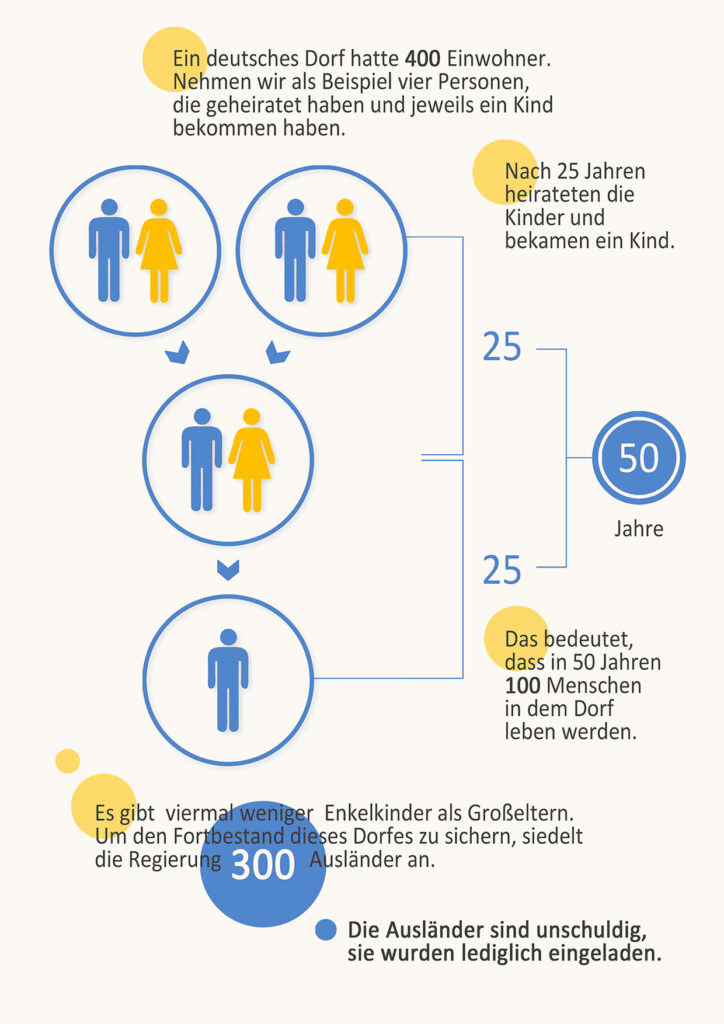
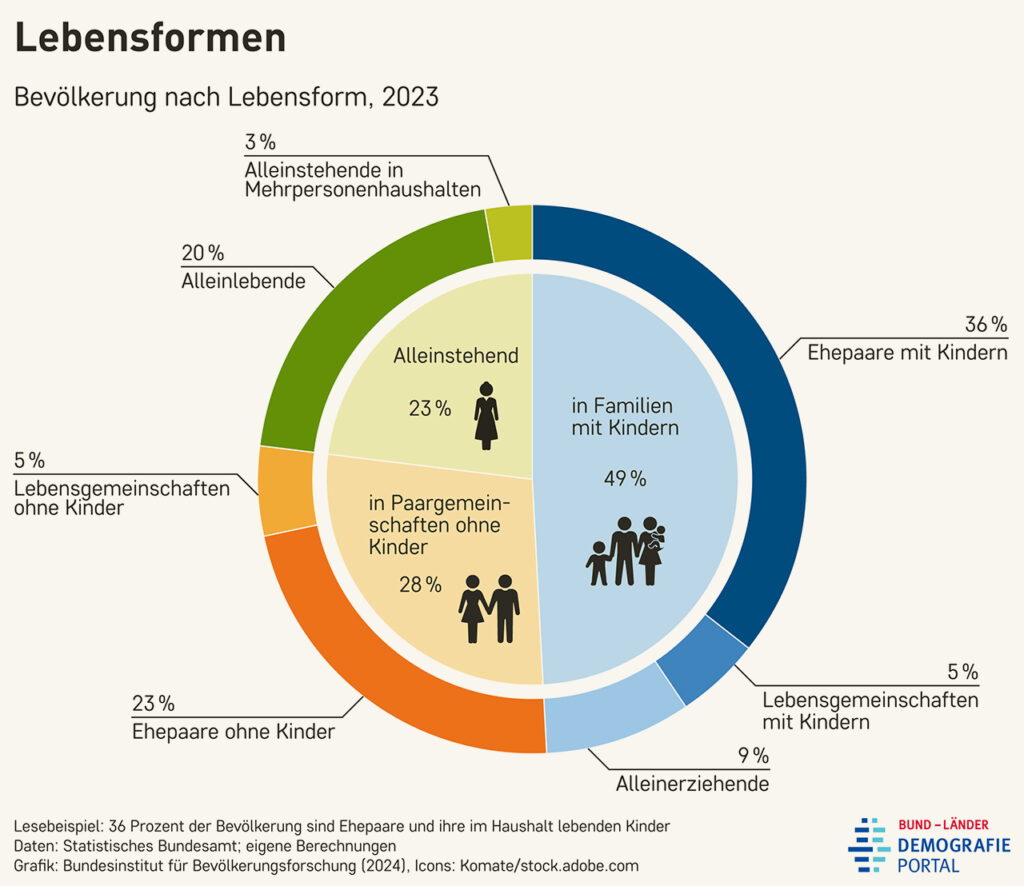
In the example above, we considered a scenario where all 400 people in a German village are married, meaning there are 200 families in the village and each family has one child. However, we chose the most favorable scenario. In the diagram below, we draw attention to the fact that 51% of the population in Germany is childless. The German village will disappear much sooner than we think.
Across the entire European Union, the fertility rate is 1.38 children per family. We are beyond the point of no return. Over time, Europe as we know it will cease to exist. However, Europe’s population is not decreasing. We are being “saved” by immigration.
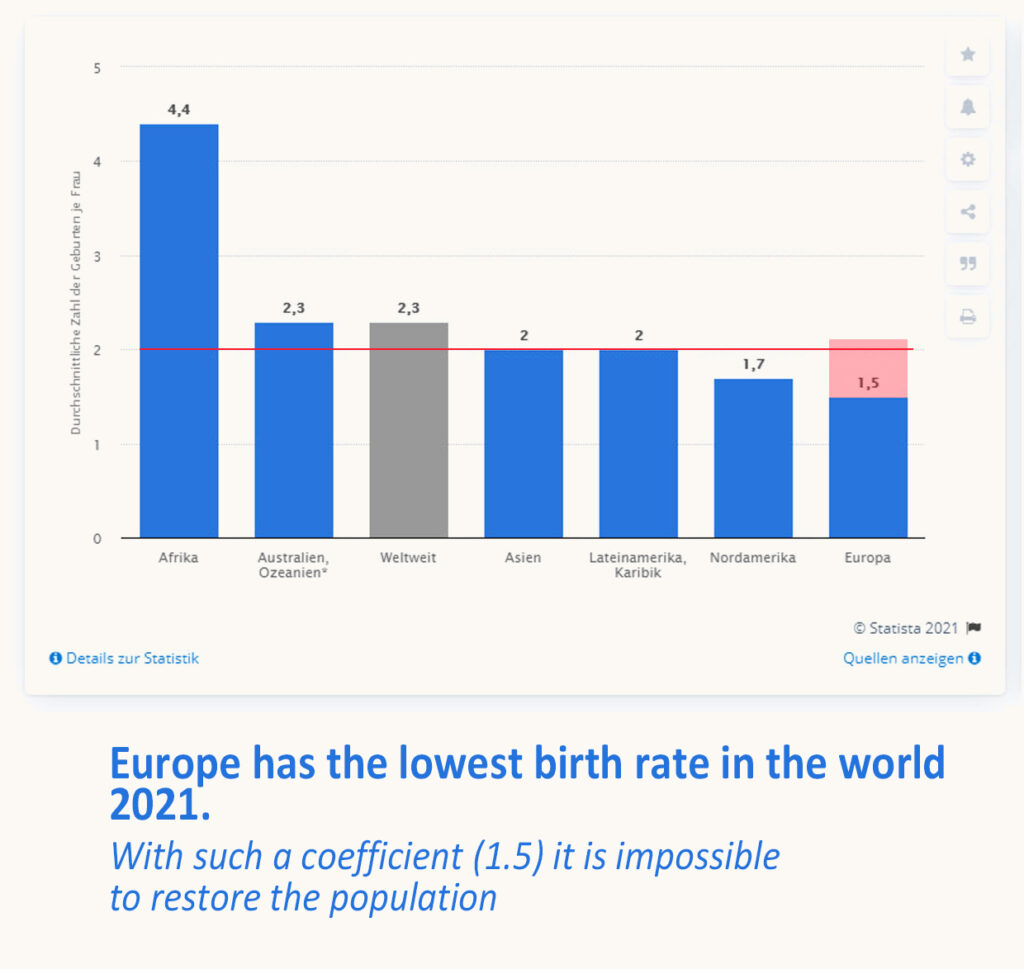
But this is not only about Europe. In Canada, for example, the fertility rate is 1.6. In the United States, it is the same. However, together with immigrants from Latin America, the rate rises to 2.11—the necessary minimum level.
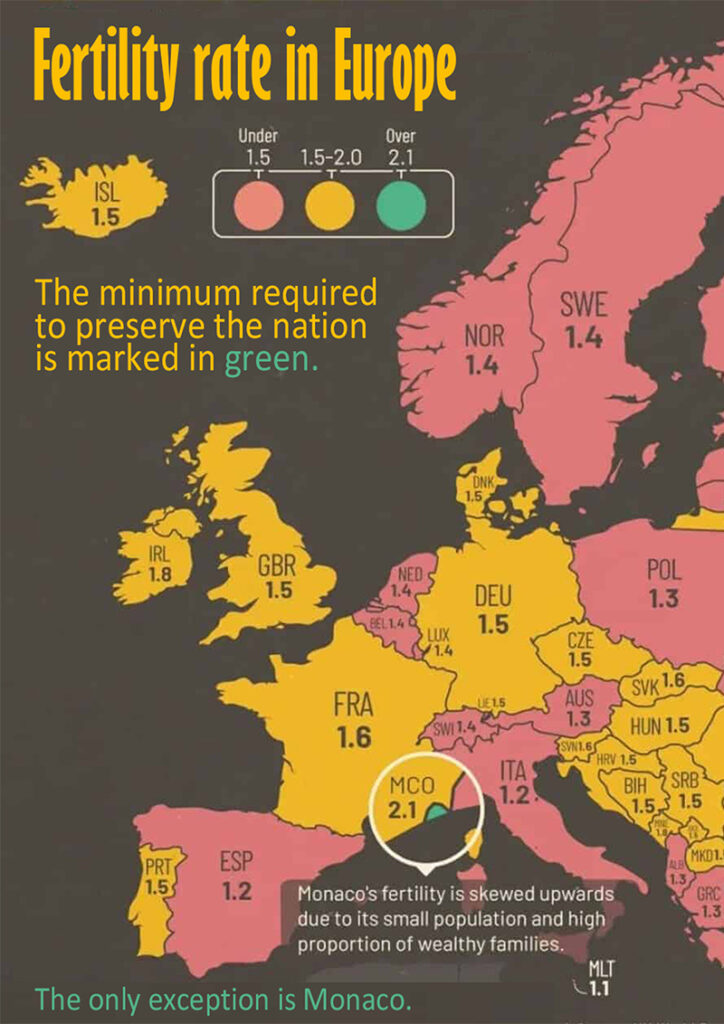
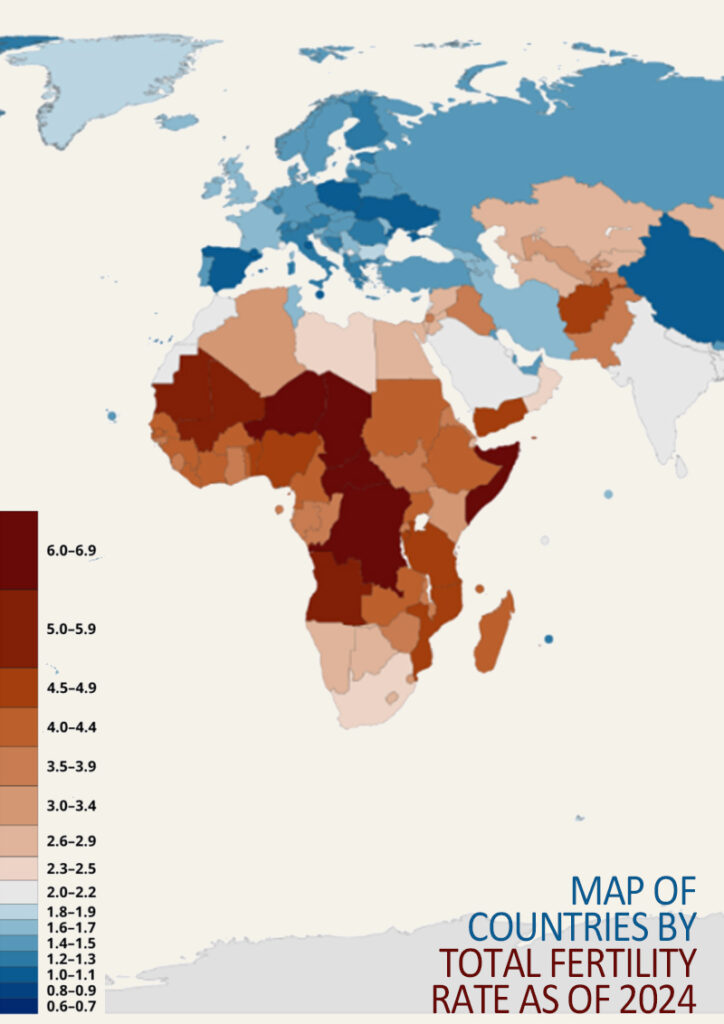
Map of countries by total fertility rate as of 2024